A scaffolding castor wheel carries the frame, workers, tools and materials while also controlling movement, height and stability. By the end, you will know how to calculate the required capacity, select the correct brake and levelling arrangement, check compatibility, and decide when a specialist manufacturer is necessary.
Key takeaways
- Use specialist engineering when casters affect scaffold load capacity or stability.
- Engage every wheel brake before workers climb or work from the scaffold.
- Choose a leveling adjustable caster on uneven floors or where precise height matters.
- Measure load, wheel diameter, mounting type, stem size and available clearance first.
When does a scaffolding wheel need specialist engineering?
A specialist is necessary when the caster supports the scaffold’s load-bearing and stability system, not merely its transport. The wheel, fork, bearings, brake, stem or mounting plate, frame connection and scaffold must work as one assembly under the fully loaded structure.
Calculate the purchasing load from scaffold mass plus workers, tools, materials and foreseeable impact. On a four-caster unit over an imperfect floor, divide that total conservatively by three carrying casters, then check the result against separate static, rolling and shock-load ratings.
A high static rating does not cover thresholds, potholes, side loading or sudden floor joints. Those forces can bend forks, damage bearings, pull stems or defeat brakes, creating scaffolding wheel problems even when the printed capacity looks adequate.
Use this approval checklist before choosing scaffolding castor wheels:
- Confirm the complete assembly is designed for the loaded scaffold, not just the wheel.
- Require positive braking that prevents movement; a wheel-only brake is not equivalent to a total-lock arrangement.
- Never move an occupied scaffold.
- Never climb or work on an unlocked wheel.
- Never exceed the scaffold manufacturer’s height-to-base limit.
- Reject any proposal that gives only one capacity number without static, rolling and shock-load ratings.
- Check that the frame, mounting interface and scaffold design match the proposed caster.
A general industrial wheel catalogue rarely proves those system-level requirements. A safety-critical mobile scaffold needs documented compatibility between the caster and the structure, floor and operating loads.
Which caster, brake and movement procedure belong on a mobile scaffold?
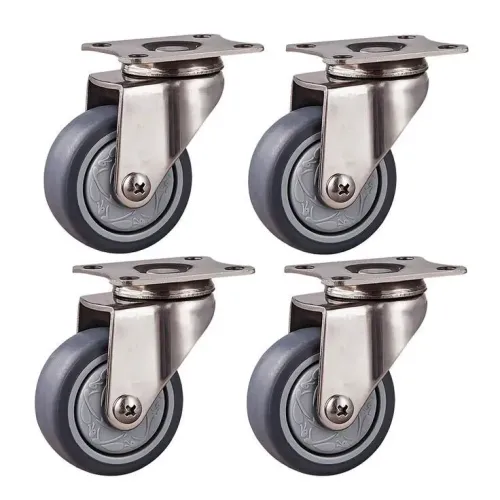
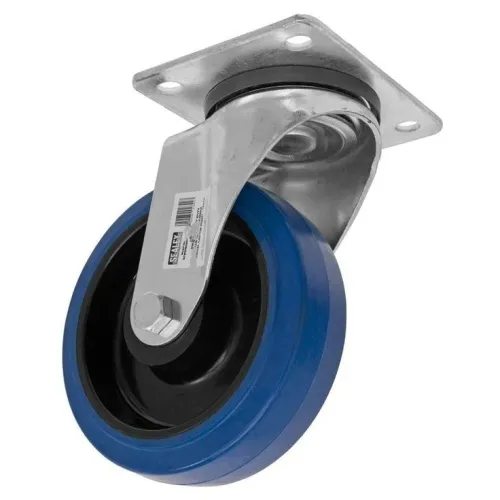
A fixed caster rolls in one direction, so it suits guided travel along a straight route. A swivel caster turns freely for manoeuvring, while a braked swivel caster resists wheel rotation but may still allow the caster to swivel. A total-lock swivel caster restrains both wheel rotation and swivel.
| Type | What it controls | Suitable use |
|---|---|---|
| Fixed caster | Travel in one direction | Guided movement |
| Swivel caster | Direction and manoeuvring | Turning in confined areas |
| Braked swivel caster | Wheel rotation only | Stationary use where swivel movement is acceptable |
| Total-lock swivel caster | Wheel rotation and swivel | Occupied scaffold that must remain fixed |
Total-lock brakes are generally the appropriate choice when a scaffold is occupied because they prevent rolling and caster pivoting. Brakes do not make a leaning, unlevel or unsquared scaffold safe, and ignoring that distinction creates serious scaffolding wheel problems.
Use this movement procedure:
- Release every brake.
- Remove people and loose materials.
- Inspect the route for openings, thresholds, debris and overhead obstructions.
- Move at walking speed.
- Stop on a level surface, then apply every brake.
- Confirm the frame is plumb and squared.
- Recheck the scaffold before climbing.
Do not drag a locked caster. Sharp turns and impacts damage forks, bearings, stems and brakes, turning a routine move into a failure risk.
When is a leveling adjustable caster better than a standard wheel?
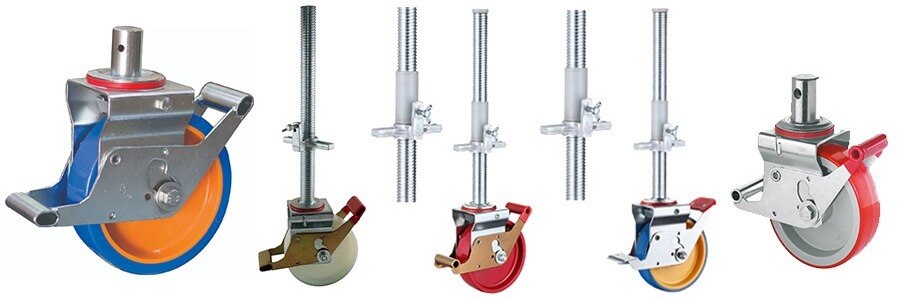
A leveling adjustable caster is better than a standard wheel on uneven floors, ramps, thresholds, grating or outdoor surfaces when the scaffold system is designed and approved for that arrangement. It combines a swivel wheel for travel, a threaded stem or adjustable leg, a locking mechanism and a levelling pad or base plate.
The wheel moves the scaffold during repositioning. Once parked, the threaded mechanism sets the height and transfers support to the pad when engaged; the wheel must be relieved from the floor, not left to carry the load accidentally. Confirm these figures before ordering:
- Adjustment stroke
- Thread size and pitch
- Minimum and maximum operating height
- Levelling-pad or base-plate capacity
- Rolling capacity
- Proof that the wheel is clear of the floor during levelling
Levelling is not the same as locking a wheel. A brake stops wheel rotation but cannot correct a slope, rocking frame or height difference between scaffold legs. That distinction prevents common scaffolding wheel problems.
Do not assume a levelling caster replaces base jacks, outriggers or other stability controls. Raising the frame can reduce the effective wheel footprint and increase overturning risk, so the scaffold design must approve the arrangement. Verify the frame remains level, plumb, squared and secured before anyone climbs it.
What must you measure before ordering a scaffolding castor wheel?
A nominal wheel diameter does not prove interchangeability. Measure the complete interface, because common scaffolding wheel problems start with the wrong stem or plate.
- Record wheel diameter, tread width, overall installed height, swivel clearance, axle diameter, mounting-plate length and width, bolt-hole centres, bolt size, stem diameter and length, threaded-stem pitch, retaining-hole position, and scaffold-tube or jack-fitting size.
- Confirm that the frame is designed to accept a castor, not a levelling jack. Specify the required washers, nuts, bolts, retaining pins and other mounting hardware.
State the working conditions with the order: smooth concrete, finished flooring, grating or contaminated outdoor ground; travel frequency; pushed or pulled loads; obstacle size; corrosion exposure; operating temperature; total loaded mass; and number of casters. Check that the complete assembly suits the scaffold’s loaded structure.
| Tread | Benefit | Trade-off |
|---|---|---|
| Hard nylon | Rolls easily on smooth concrete | Can be noisy and damage finished flooring |
| Polyurethane | Reduces noise and floor marking | Resistance, cut, chemical and heat limits differ |
| Elastomeric | Cushions movement and protects floors | Can increase rolling resistance and suffer under cuts, chemicals, heat or prolonged loading |
A larger diameter crosses joints and debris more easily, but raises the scaffold and can alter its centre of gravity. Do not approve a quotation until the drawing, dimensions, rating basis and frame fit match your measurements.
What should you demand from a Pune caster manufacturer before buying?
Treat “pioneer caster wheel manufacturer” as a search description, not proof of technical suitability. For a search such as “pioneer caster wheel manufacturer scaffolding castor wheel in pune,” request these items before comparing prices:
- Dimensional drawing, wheel and tread material, brake type, adjustment details and mounting interface
- Declared basis for static, rolling and shock-load ratings, plus test information
- Batch traceability, warranty terms and replacement-part availability
The quotation must name the complete assembly: wheel diameter and width, swivel or rigid fork, total-lock or wheel-only brake, stem or mounting plate, hardware and any levelling mechanism. “Scaffold wheel” alone hides differences that prevent interchangeability.
Prime Distributors becomes relevant when a Pune buyer needs to turn these requirements into a specified industrial or scaffolding castor assembly, compare alternatives and confirm the interface before purchase. Ask the manufacturer or supplier to relate the choice to the loaded scaffold, floor, movement pattern and frame—not simply repeat a capacity number.
| Claim | Evidence to request | Failure if absent |
|---|---|---|
| Static capacity | Load calculation and stated test basis | A high number may not cover rolling or impact |
| Rolling capacity | Floor, speed and obstacle assumptions | Thresholds or joints can overload the caster |
| Shock capacity | Defined impact condition and test information | Forks, stems or brakes can fail suddenly |
Do not install until the drawing, rating basis and scaffold-frame fit have been checked by the responsible person.
Related product
 | Scaffolding Series Our Scaffolding Series is ahving load capacities to ensure safe and stable work environments. perfect for use in the Aerospace production industry. View product → |
Frequently asked questions
When does a scaffolding wheel need specialist engineering?
Use specialist engineering when the caster carries the loaded scaffold, affects stability, or must integrate with the frame connection, brake and mounting system. Check the complete assembly rather than selecting a wheel by diameter alone.
Which caster, brake and movement procedure belong on a mobile scaffold?
Specify a caster rated for the fully loaded scaffold, with a positive wheel or swivel brake suited to the application. Move the scaffold only after workers, tools and loose materials are removed; release the brakes for movement, then place the scaffold on the intended surface and engage every brake before use.
When is a leveling adjustable caster better than a standard wheel?
Choose a leveling adjustable caster when the floor is uneven, the scaffold must be set precisely to height, or the wheel must support the structure after leveling. A standard wheel suits transport on a reasonably level surface when height adjustment is unnecessary.
What must you measure before ordering a scaffolding castor wheel?
Record the fully loaded scaffold weight, number of load-bearing casters, wheel diameter and width, mounting plate or stem dimensions, bolt-hole pattern, overall height, swivel clearance and brake clearance. Confirm the floor condition and required working height.
What should you demand from a Pune caster manufacturer before buying?
Ask for the caster’s rated load, wheel and fork materials, brake type, mounting dimensions, bearing details, adjustment range for a leveling caster, inspection or test records, and written installation and maintenance instructions.